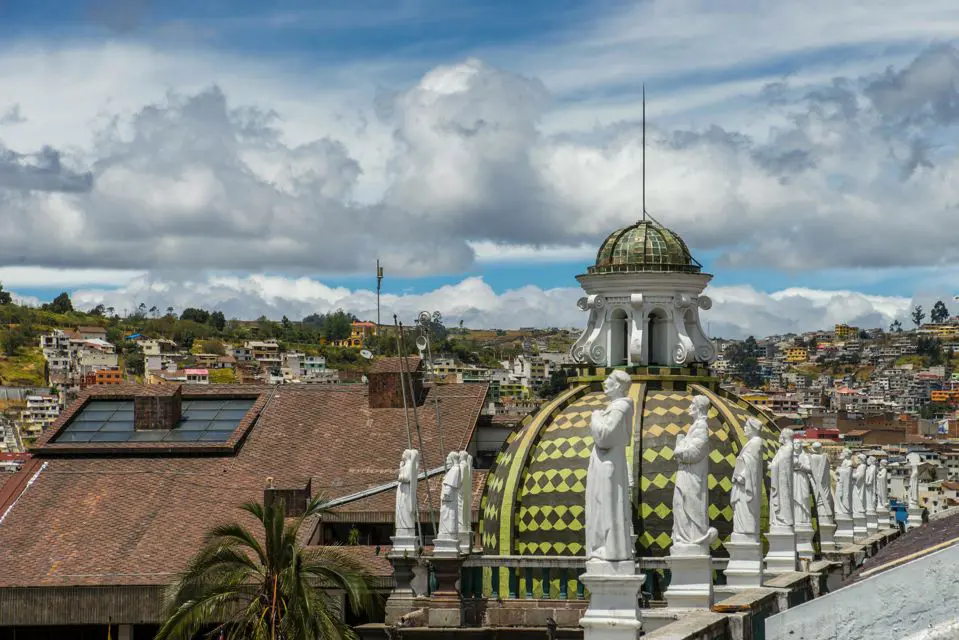
So you have a very special day ahead to know the essential places of Quito. Then there is no time to lose! If in your notepad there is an infinite list of attractions to visit in the Ecuadorian capital, we help you define what are the things that cannot be left out of your tour.
In this article, we propose an express itinerary, designed for you to discover the best activities in Quito in a day, passing through places allowing you to appreciate the rich and varied history, identity, and culture of this people. Shall we go?
First Hours in Quito: Context and Acclimatization
We know you really want to go out right now to walk through the historic center, but stop there! Do not leave without a bottle of water, coca leaves or candies, fan, raincoat, and sunglasses. These elements will help you alleviate the walk through tourist places in Quito, a city that being at 2,850 meters above sea level, has streets with significant ups and downs, plus unstable weather depending on the season.
The ideal is to start the day calmly, walking at a leisurely pace and letting the body adapt to the altitude. The first thing you will notice is that it is one of the oldest cities in South America: you will bump into churches, squares, convents, and mansions built since colonial times, and maintained in an admirable state.
Thus, the historic center becomes a true open-air museum. For all this is that it was one of the first cities in the region to be declared Cultural Heritage of Humanity by UNESCO.
What to Do in the Historic Center of Quito
The best point to start the tour is the Plaza de la Independencia, also known as Plaza Grande. At its heart, a monument celebrating the country's sovereignty. And of course, this space marks the political and historical heart of the city and is surrounded by fundamental buildings such as the Carondelet Palace, the Metropolitan Cathedral, and the Archbishop's Palace. From here it is easy to orient yourself and stroll around. In addition, you will find offers from tour guides telling the most relevant details of this key sector of the city and anecdotes enriching the experience.
Once you have completed the visit to those five attractions, half a block away awaits the Pasaje Arzobispal, a beautiful internal courtyard surrounded by two-story buildings, with balconies full of plants and vines. There you can take a break to reinforce breakfast, or simply stop to contemplate and recharge energies.
When you are ready to continue, three blocks away appears one of the city's great unmissables: the Church of the Company of Jesus (Iglesia de la Compañía de Jesús). Its baroque facade already impacts, but the interior covered in gold leaf directly leaves you speechless. It is one of the most important works of Latin American baroque and a mandatory stop, even if you are not one to visit temples on your tourist trips. In this same line, a few meters away is the Church and Convent of San Francisco, offering a different experience. Its huge square, its staircase, and its interior full of art from the Quito School allow sizing up the religious and cultural importance of the place during the colonial era.
There is a short but interesting walk on the so-called “Street of the Seven Crosses” (Calle de las Siete Cruces), on García Moreno street. It is an artery famous for housing seven stone crosses in front of churches and convents dating from the colonial era, since 1500. With its back to the famous Virgin of El Panecillo, it symbolizes evangelization over sacred Andean sites.
To know all these sites without wasting time and, above all, understanding the stories they hide, an excellent option is to take our excursion “Secrets of Quito”, a guided tour through the historic center connecting the most emblematic points with legends, curious facts, and corners many travelers overlook. In a few hours, it allows understanding the city far beyond what is seen with the naked eye.
Midday: Museums, Theater, and Lunch Break
After touring the main churches and squares, midday is ideal to add an indoor cultural visit. The City Museum (Museo de la Ciudad) is a great alternative to understand the historical and social evolution of Quito, from pre-Hispanic times to the present, through dynamic and well-contextualized exhibitions.
Another interesting option is the Casa del Alabado – Pre-Columbian Art Museum, gathering one of the country's most valuable collections and allowing knowledge of the worldview of original cultures of Ecuadorian territory. It is a brief but very enriching visit to complete the historical panorama.
Another recommendation is visiting the Teatro Nacional Sucre, which is one of the oldest opera houses in South America and the city of Quito, besides being the most prestigious theater in Ecuador. It was built between 1879 and 1886 by order of President Ignacio de Veintimilla, following a European-inspired model, as its style is Italian. And since you are passing through that area, how about stopping for lunch at the Central Market of Quito? Spectacular Ecuadorian food stalls await you there, such as Las Corvinas de Don Jimmy, where exquisite corvina with potatoes and mixed ceviche is served.
Other local lunch options are menestras, a typical Ecuadorian dish with rice, eggs, and beans, plus an extra ingredient (chicken stew, loin, breaded chicken, etc.); or an encebollado, a dish originating from the coast which is in turn one of the richest in the country.
And if during the walk you are left with the feeling of wanting to explore more, a good alternative for another day—or even to better organize the trip—is to opt for a guided excursion from Quito. The tour to Otavalo, its market, and surroundings is ideal if you want to save time on transfers and, at the same time, add deep knowledge about indigenous communities, their traditions, and artisanal production.
Afternoon of Viewpoints and Panoramic Views
Seeing Quito from above is an essential part of the experience. In the afternoon, one of the best options is to approach the Basilica of the National Vow (Basílica del Voto Nacional). This imposing neo-Gothic cathedral dominates the urban landscape and is distinguished by a unique detail: instead of traditional gargoyles, it presents figures of animals representative of Ecuador's regions. Climbing its towers allows obtaining some of the best panoramic views of the city, with the historic center to the south, modern neighborhoods to the north, and, on clear days, the volcanoes surrounding Quito.
Another alternative for those seeking an even more panoramic experience is the Teleférico de Quito, ascending to Cruz Loma. From that point, spectacular views of the Andes are obtained, and gentle hikes can be made, ideal for combining nature and city on the same day.
Sunset and Night in La Ronda
When the sun begins to set, the perfect plan is to head to La Ronda, one of the most traditional and picturesque streets in the historic center. This sector comes alive in the evening and night, with lit lanterns, live music, handicrafts, and typical restaurants. It is the ideal place to close the day trying dishes of Ecuadorian cuisine, drinking a local craft beer, or daring a canelazo, the typical hot drink of Quito. The atmosphere is relaxed, festive, and very authentic, perfect for saying goodbye to the city.
Published by Has Chacon on 27/02/2026