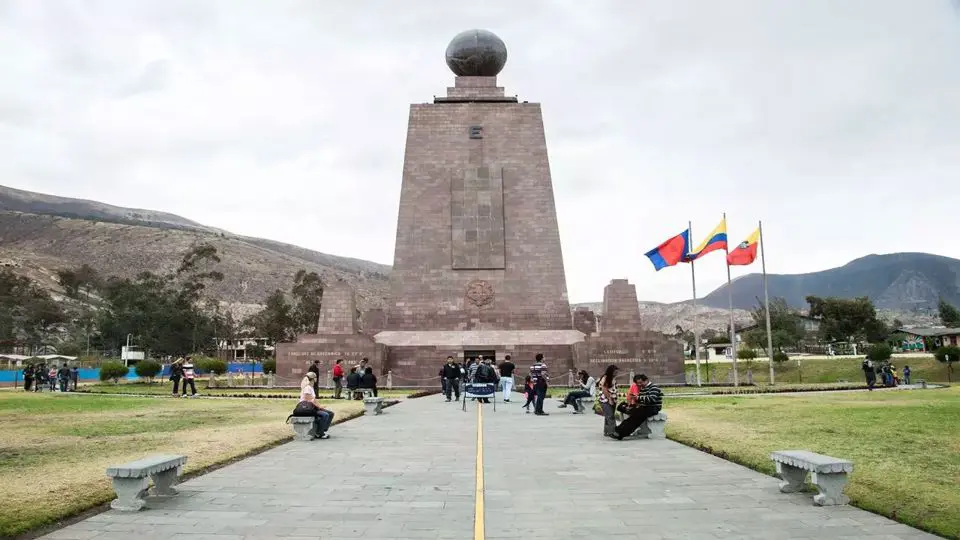
If you are thinking of visiting tourist attractions in Quito, the Mitad del Mundo (Middle of the World) has to be on your itinerary. That is why, in this article, we recommend visiting this place, where you will be able to joke around saying with pride and total certainty that you are, or feel like, "the center of the world".
It is not just about an imaginary line drawn on the ground or a classic photo with one foot in each hemisphere: this site concentrates centuries of scientific exploration, fundamental debates about the shape of the Earth, and a national identity built around geography.
Below, you will learn how to get there and what to do during your visit. Additionally, you can check other recommendations for tours and travel packages to Quito to arrive in the Ecuadorian capital with everything organized.
Where is the Mitad del Mundo Located?
The Mitad del Mundo is located in the parish of San Antonio de Pichincha, about 25 kilometers north of Quito, within the Pichincha province. The setting is a dry Andean valley, surrounded by rolling hills, which contrasts with the urban center of the Ecuadorian capital. Thanks to this proximity, it is one of the most popular excursions for those visiting Quito for a few days who want to add an iconic attraction without straying too far.
Getting there is simple. From the city, you can opt for public transport, combining buses that leave from the north of Quito towards the Mitad del Mundo area. The journey takes between an hour and an hour and a half, depending on traffic. For those looking for greater comfort, taxis or ride-hailing apps allow you to arrive directly in about 40 or 45 minutes.
The best alternative is to take our tour from Quito to the Mitad del Mundo, which includes transfers and guided explanations, among other services.
Mitad del Mundo Monument in Quito
The famous Mitad del Mundo monument is a 30-meter structure crowned by a globe. At its base, a yellow line symbolically marks the passage of the 0° parallel, and it is there where millions of visitors take the classic photograph with one foot in each hemisphere.
It was built in the 20th century as a tribute to the scientific missions that built the first knowledge about the place. In the 18th century, the European scientific community debated whether the Earth was perfectly spherical or if, as Isaac Newton proposed, it was flattened at the poles. Resolving that discussion was not a minor detail: it implied redefining cartography, navigation, and the understanding of the planet itself.
To verify this, the French Academy of Sciences sent a geodesic mission to Ecuador in 1736, led by scientists such as Charles-Marie de La Condamine. The reason for choosing this region was clear: measuring an arc of the terrestrial meridian at the equatorial line and comparing it with measurements taken near the poles would allow confirming the real shape of the Earth.
After years of astronomical observations, calculations, and fieldwork, the results showed that the planet is not a perfect sphere, but an oblate spheroid, slightly bulged at the Equator and flattened at the ends. This finding marked a before and after in geodesy and turned the Ecuadorian region into a world reference point for science. The Mitad del Mundo, as it is known today, is a direct heir to that history of exploration, measurement, and knowledge.
With the advancement of technology and the arrival of GPS, it was discovered that the exact location of the real 0° is about 240 meters from the monument, within the area where the Museo Intiñan operates today. Far from detracting from it, this fact adds another layer of interest to the place: it shows how science evolves and how measurements, although precise for their time, are perfected with new tools. The monument remains a historical and cultural symbol, while the debate over the exact location of the Equator adds curiosity and conversation to the visit.
Experiments at the Mitad del Mundo Park
One of the great attractions of the Mitad del Mundo is the possibility of experiencing, firsthand, some phenomena associated with the equatorial location. Many of these experiments are presented at the Museo Intiñan, which combines scientific explanations with interactive demonstrations designed for all audiences.
The best known is related to the Coriolis effect, a consequence of the Earth's rotation that influences the movement of large masses of air and water, such as ocean currents and weather systems. In the museum, demonstrations are performed with water that supposedly drains in different directions depending on the hemisphere.
From a scientific point of view, the Coriolis effect is real, but it only manifests measurably on a large scale. In small containers, such as sinks, the spin of the water depends more on the shape of the container and how the liquid is introduced than on the earth's rotation. Even so, the experience is useful for understanding the concept and opening the door to a deeper explanation.
Another popular experiment is balancing an egg on a nail. Visitors are invited to try to keep an egg balanced right on the equatorial line. The explanation accompanying the activity mentions that, at the Equator, the centrifugal force generated by the planet's rotation is slightly greater, which minimally reduces the effective weight of objects.
In practice, the difference is so small that it is not perceived without high-precision instruments, and the success of the experiment depends more on patience and a steady hand than on latitude. However, it serves to introduce a real concept: at the Equator, effectively, one weighs a few grams less than at the poles, something imperceptible to the human body but relevant in geophysical calculations.
There is also talk of balance and body orientation, associating the equatorial line with a supposed neutrality. From science, there is no evidence that human balance changes by being at the Equator, but these explanations are intertwined with ancestral worldviews that understood this point as a space of balance between forces. That mixture of physics, history, and traditional knowledge is part of the charm of the place.
Tourist Spots Near the Mitad del Mundo
The area lends itself to combining the excursion to Mitad del Mundo with tourist attractions in Quito, such as natural viewpoints or the Pululahua crater, one of the few inhabited craters in the world.
The tourist complex is designed as a space to tour calmly, enjoy, and stay for a good while. Inside and in the surroundings, there are restaurants where you can have lunch or a snack, with proposals ranging from typical Ecuadorian dishes, such as locro de papa (potato soup) or empanadas, to more international options and coffee shops ideal for a break.
Craft fairs are another great attraction. There you can find textiles, jewelry made with tagua (vegetable ivory), ceramics, and traditional souvenirs, many of them made by local artisans. Strolling among the stalls allows you to take a little piece of Ecuadorian culture with you and close the visit with a relaxed plan.
Published by Has Chacon on 08/06/2026