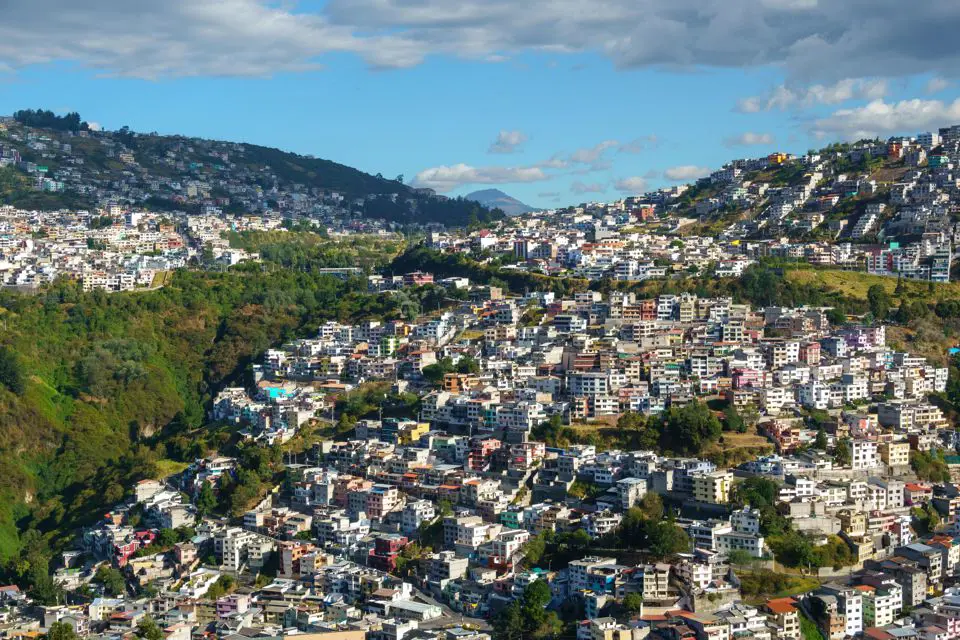
If you are planning your first trip to Ecuador, it is logical to wonder what is the best time to visit Quito. Located nearly 2,800 meters above sea level and crossed by the equatorial line dividing the planet into the northern and southern hemispheres, the Ecuadorian capital arouses curiosity... and also some doubts. Thus, knowing what the climate of Quito is like is key to making the most of every tour, but it is not the only factor to consider.
You will surely be interested to know that throughout the year, Quito is enriched with a calendar full of festivities, celebrations, and cultural events that can transform and enhance your experience. Therefore, we are going to highlight the unmissable, in addition to recommending travel packages to Quito and excursions to do at any time.
What is the Weather Like in Quito Throughout the Year
Quito is one of those cities that force you to pack warm clothes for the night in your suitcase, even if you travel in the spring or summer seasons. Don't be fooled by its position far from the poles, where it is cold: being the second highest capital in South America, after La Paz, greatly influences the climatic conditions of every day and hour, so it is always recommended to check the forecast before planning a walk or paying for an outdoor excursion.
Unlike many destinations, in the capital of Ecuador, summer and winter are just labels for temporal orientation. Throughout the year, Quito has a temperate climate due to the following: although it is close to the equatorial line, the altitude softens the temperatures, so marks generally range between 10 °C and 20 °C (50°F - 68°F). However, there can be a notable contrast between the warmth of the day and the cold of the night.
When is the Dry Season in Quito
While in Quito winter and summer barely differ, what really marks a distinction in the region is the rainfall factor. Basically, two seasons are distinguished in Quito: the dry season and the wet or rainy season.
The first runs approximately from June to September and is, for many travelers, the most attractive time: days are usually sunnier and perfect for exploring the city and its surroundings, without rain or drizzle interrupting your plans. This period is characterized by clearer skies and more colorful landscapes, ideal if you are interested in walks through the Historic Center, tours to the Virgen del Panecillo viewpoint, or excursions along the Avenue of the Volcanoes, such as Cotopaxi or Quilotoa.
On the other hand, between October and May, Quito enters its rainy season. This does not mean it will rain all day long, but it is very common to enjoy beautiful sunny mornings and precipitation in the afternoons. Sometimes these rains are accompanied by electrical activity, which can also be a charming experience if you travel with curiosity about mountain weather. The advantage of visiting at this time is that the city is greener, nearby rivers and waterfalls look more voluminous, and prices for some tourist activities may be more accessible.
How to Prepare for Quito's Climate
With all this said, what we recommend is to bring light clothing and some warm clothes in your suitcase to dress in layers as the sun goes down and temperatures drop. Meanwhile, it doesn't hurt to have an umbrella or a raincoat among your garments, in case the rains surprise you in the afternoon in the middle of an excursion or walk.
Fiestas de Quito: Important Dates Not to Miss
Beyond the weather, another factor that can influence your decision on when to travel to Quito is its cultural and festive calendar. Quito has celebrations that attract both neighbors from other cities and travelers from bordering countries and further afield. Living a festive experience in Ecuador will undoubtedly add memorable moments to your trip.
One of the most emblematic celebrations occurs every year between late November and the first days of December, around the anniversary of the city's foundation. Although December 6 is the traditional date of Quito's foundation, activities usually extend for more days, with parades, shows, crafts and regional products fairs, gastronomic events, and spectacles of all kinds. This celebration is known in the city as the Fiestas de Quito, and during these weeks there is a very active cultural agenda with neighborhood parades, free concerts, and much more.
Another influential celebration in the area between the months of February and March is the Carnaval de Amaguaña, an event lasting several days that summons thousands of Quiteños to enjoy colorful parades, floats in the streets, foam fights, and typical popular food at affordable prices, plus lots of music and fun activities until dawn.
If religious and traditional festivities are your thing, the Fiesta de la Virgen del Quinche, patron saint of Quito, is another of those celebrations deeply rooted in the community. Although many popular celebrations of this holiday take place on specific dates and with processions that can last days, the proximity to traditional activities, devotion, and community gatherings makes it a different experience if you visit during that period. If you are not a person who practices any religion, we suggest that on that date you put personal judgments aside.
Finally, in honor of the colada morada, which is a traditional Ecuadorian drink made with black corn, fruits, and spices; we suggest traveling in the last days of October and early November, since for the Day of the Dead (Día de los Difuntos) this typical drink is usually prepared and served massively to honor deceased loved ones. It is traditionally consumed accompanied by guaguas de pan.
So much information! All this means that there is no single "best" time to travel to Quito: the city is charming all year round. If you prefer a drier and more stable climate for outdoor activities, the months of June to September are ideal. However, if the idea of living Quito's cultural energy appeals to you, planning your trip for late November and December will allow you to enjoy its most important festivals, with parades, music, floats, and a vibrant atmosphere that makes the Quito identity felt in the streets.
But even the rainy season has its charm: luminous sunrises, exuberant Andean landscapes, the possibility of seeing how the weather changes in a few hours, and better prices. And since Quito is in a strategic region of the Andes, you can also combine your visit with excursions to adventure destinations, where there are volcanoes and lagoons inside a crater, or where the world is divided in two. Each season offers something special, and the city is always ready to surprise.
Published by Has Chacon on 17/02/2026